CODE: 14
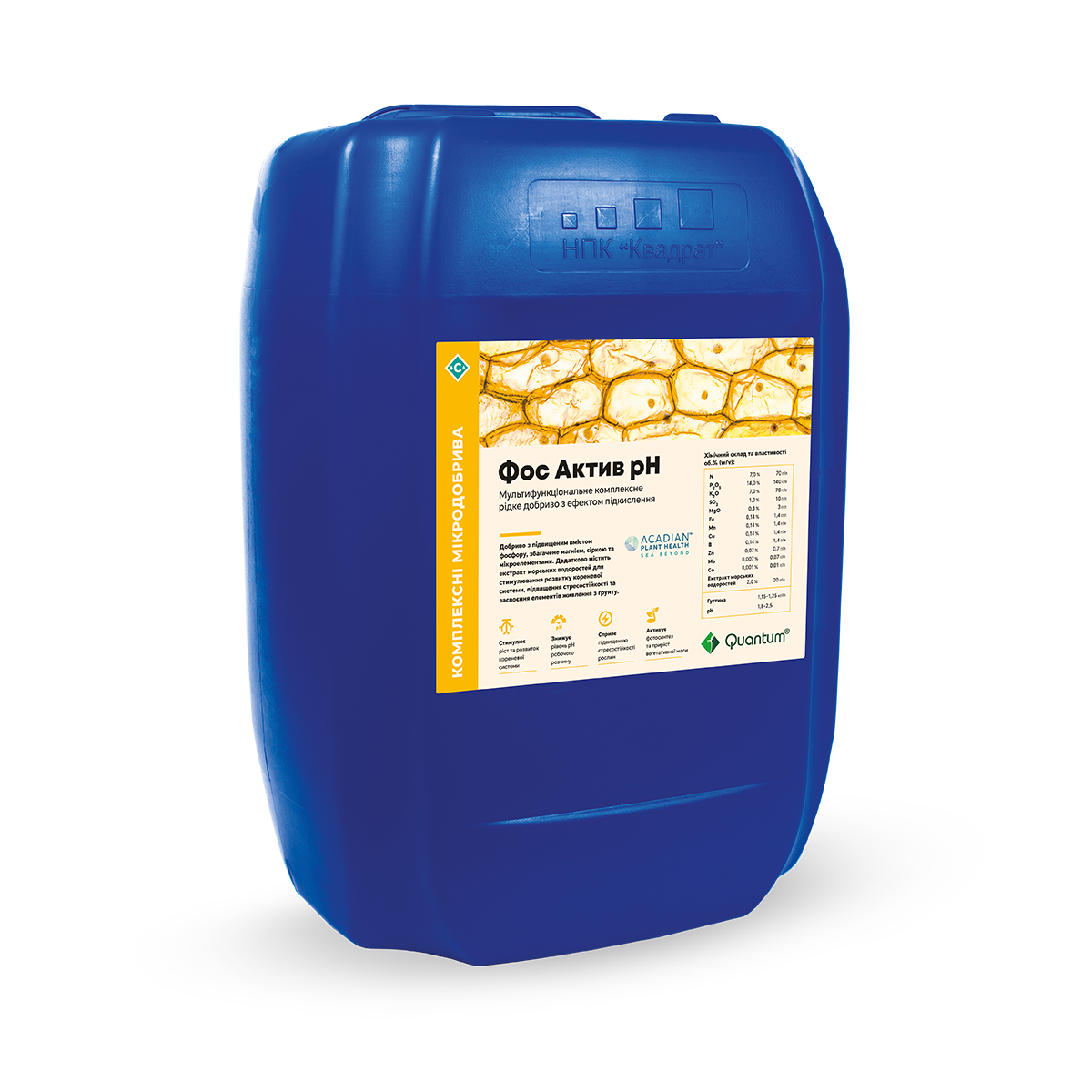
Quantum Fos Active pH
This fertilizer is enriched with magnesium, sulfur, and micronutrients, and also contains seaweed extract to stimulate root system development, increase stress tolerance, and enhance the uptake of nutrients from the soil. It exhibits buffering and acidifying properties in tank mixes.
Product information
- N – 7% (70 g/L)
- P₂O₅ – 14% (140 g/L)
- K2O – 7% (70 g/L)
- SO₃ – 1.0% (10 g/L)
- MgO – 0.3% (3 g/L)
- Fe – 0.14% (1.4 g/L)
- Mn – 0.14% (1.4 g/L)
- Cu – 0.14% (1.4 g/L)
- B – 0.14% (1.4 g/L)
- Zn – 0.07% (0.7 g/L)
- Mo – 0.007% (0.07 g/L)
- Co – 0.001% (0.01 g/L)
- Seaweed extract – 2% (20 g/L)
- pH – 1.8–2.5
- Density – 1.15–1.25 kg/L
Composition is given in % w/v (weight/volume) – 1% w/v = 10 g/L
Effects and Benefits of Micronutrient Fertilizer
- Designed to correct nutrient deficiencies, primarily phosphorus and potassium, caused by soil, weather, climate, and chemical factors.
- Quantum Phos Active pH, thanks to its buffering properties and low pH (acidic reaction), creates optimal characteristics for the working solution when used in combination with alkaline fertilizers and plant protection products that are particularly sensitive to alkaline hydrolysis. In this case, the product has a dual action: providing comprehensive plant nutrition and acidifying the working solution. The use of Quantum Phos Active pH with boretanolamine-based fertilizers (e.g., Quantum Bor Active, Bor Classic, Bor Active+Mo) in tank mixes with fungicides and other pesticides that are sensitive to alkaline environments. For additional nitrogen nutrition, combined application with Quantum Slow Nitrogen is recommended; to correct micronutrient deficiencies—Quantum TPIO; and for a stimulating effect—Quantum ExtraPhos and Quantum SiAmin or Quantum Humate. The trace-element metals are present in chelated form, ensuring high bioavailability to plants and stability in working solutions.
- The increased phosphorus content stimulates root system development during the early stages of growth and improves flowering during the generative phase.
- Seaweed extract helps stimulate the growth and development of the root system, improves water retention and the uptake of nutrients from the soil, and activates the enzymatic defense system, thereby promoting plant growth.
- Potassium promotes the accumulation of sugars, increases protein content (in cereals and legumes) and fat content in oilseed crops, improves water exchange, and enhances drought tolerance.
- Nitrogen, sulfur, magnesium, and micronutrients promote photosynthesis and the growth of vegetative mass.

In the production of the Fos Active pH fertilizer, high-quality concentrated raw materials from Acadian Seaplants (Canada) derived from the seaweed Ascophyllum nodosum are used.
Acadian© seaweed extract:
- stimulates root growth and improves moisture retention;
- normalizes hormonal balance;
- exhibits auxin-like activity, which stimulates root growth and the formation of vascular tissues;
- stimulates the synthesis of antioxidants and proline, and protects chlorophyll during periods of stress;
- increases drought tolerance and improves water exchange by regulating stomatal function, helping to retain moisture during periods of water stress.
The product has an acidic pH. It is recommended to add it to the tank mix first.
The product is intended for use exclusively in tank mixes with other fertilizers and pesticides, as it has a pronounced acidifying effect (lowers the pH level).
| Field Crops | ||
|---|---|---|
| Crop | Growth and development stage | Application rate, L/ha |
| Cereal crops | Tillering (BBCH 21–29) | 2.0–4.0 |
| Stem elongation – flag leaf stage (BBCH 30–49) | 1.5–3.0 | |
| Milky-waxy maturity (BBCH 83–87) | 1.5–3.0 | |
| Corn | 3–5 leaves (BBCH 13–15) | 2.0–4.0 |
| 6–8 leaves (BBCH 16–18) | 2.0–4.0 | |
| Start of stem elongation – start of tassel emergence (BBCH 30–51) (at 7–10-day intervals) |
1.5–3.0 | |
| Sunflower | 2–3 pairs of leaves (BBCH 14–16) | 2.0–4.0 |
| 5–6 pairs of leaves (10–12 leaves) (BBCH 30–33) | 2.0–4.0 | |
| Rapeseed | 4–6 leaves (before winter, for winter rapeseed) (BBCH 14–16) | 2.0–4.0 |
| Spring rosette – stem elongation (BBCH 21–39) | 2.0–4.0 | |
| Budding – before flowering (BBCH 50–61) | 2.0–4.0 | |
| Seed formation (BBCH 71–79) | 2.0–4.0 | |
| Soybeans, peas | 3–5 trifoliate leaves (BBCH 14–16) | 2.0–4.0 |
| Budding – beginning of flowering (BBCH 51–61) | 2.0–4.0 | |
| Pod formation (BBCH 71–79) | 2.0–4.0 | |
| Vegetables | ||
|---|---|---|
| Crop | Growth and development stage | Application rate, L/ha |
| Sugar and fodder beets | 4–6 leaves – leaves closing in rows (BBCH 14–34) | 2.0–4.0 |
| Leaves closing in the inter-rows – root growth (BBCH 35–49) | 2.0–4.0 | |
| Potatoes | Stem elongation (BBCH 21–39) | 3.0–5.0 |
| Budding – onset of wilting and dieback of foliage (BBCH 51–97) (at 7–10-day intervals) |
3.0–5.0 | |
| Tomatoes, peppers, eggplants | 5–8 leaves (BBCH 15–18) | 3.0–5.0 |
| Budding – onset of fruit ripening (BBCH 51–71) (at 7–10-day intervals) |
3.0–5.0 | |
| Cucumbers | Leaf growth and development (BBCH 13–29) (at 7–10-day intervals) | 3.0–4.0 |
| Budding – fruiting (BBCH 51–89) (at 7–10-day intervals) | 3.0–4.0 | |
| Carrots | 4–6 true leaves (BBCH 14–16) | 3.0–5.0 |
| Root growth (BBCH 41–49) (at 7–10-day intervals) | 3.0–5.0 | |
| Onions, garlic | From the start of bulb formation to the end of bulb filling (BBCH 41–49) (at 7–10-day intervals) |
3.0–5.0 |
| Cabbage | Head formation (BBCH 41–49) (at 7–10-day intervals) | 3.0–5.0 |
| Fruit and Berry Crops | ||
|---|---|---|
| Crop | Growth and development stage | Application rate, L/100 L of water |
| Pome fruits (apple, pear, quince) | Bud break (BBCH 51–59) | 0.5–0.8 |
| Post-bloom (BBCH 71–72) | 0.5–0.8 | |
| Fruit development – harvest (BBCH 74–89) (at 7–10-day intervals) | 0.5–0.8 | |
| Stone fruits (apricot, peach, sweet cherry, sour cherry) | Bud set (BBCH 51–59) | 0.5–0.8 |
| Petal fall (BBCH 67–69) | 0.5–0.8 | |
| Fruit set (BBCH 71–73) (at 7–10-day intervals) | 0.5–0.8 | |
| Grapes | Flowering (BBCH 61–69) | 0.3–0.7 |
| Berry growth (BBCH 71–79) (at 7–10-day intervals) | 0.3–0.7 | |
| Berries (strawberries, currants, raspberries) | Leaf growth, onset of stolon formation – bud set (BBCH 41–59) | 1.0–1.3 |
| Flowering stage (BBCH 61–69) (at 7–10-day intervals) | 1.0–1.3 | |
| Nuts | Fruit set and development (BBCH 71–89) (at 7–10-day intervals) | 0.3–0.7 |
Packaging
20 л
Виробник
Quantum
Вид
Фосфорні добрива

Pickup from AGROVIO warehouse
FREE OF CHARGE
Nova Poshta delivery service
According to service rates
Ukrposhta delivery service
According to service rates
Meest delivery service MAIL
According to service rates1.Payment at the post office upon receipt
2.Payment to a Privat Bank card
3.Online payment by card, any bank
4.Cashless payment (with VAT)
1. Only certified products
2. Exchange and return of goods within 14 days
3. Return of cubic containers from the Customer is carried out at the expense of the Manufacturer, provided that the quantity is a multiple of the full load of the truck
(not less than 52 pcs). Return of a smaller volume is carried out at the expense of the Customer.
4. Delivery of microfertilizers TM QUANTUM in a volume of 4000 l or more is carried out at the expense of the Manufacturer. Delivery of a smaller volume of products is carried out at the expense of the Customer.
