CODE: 11
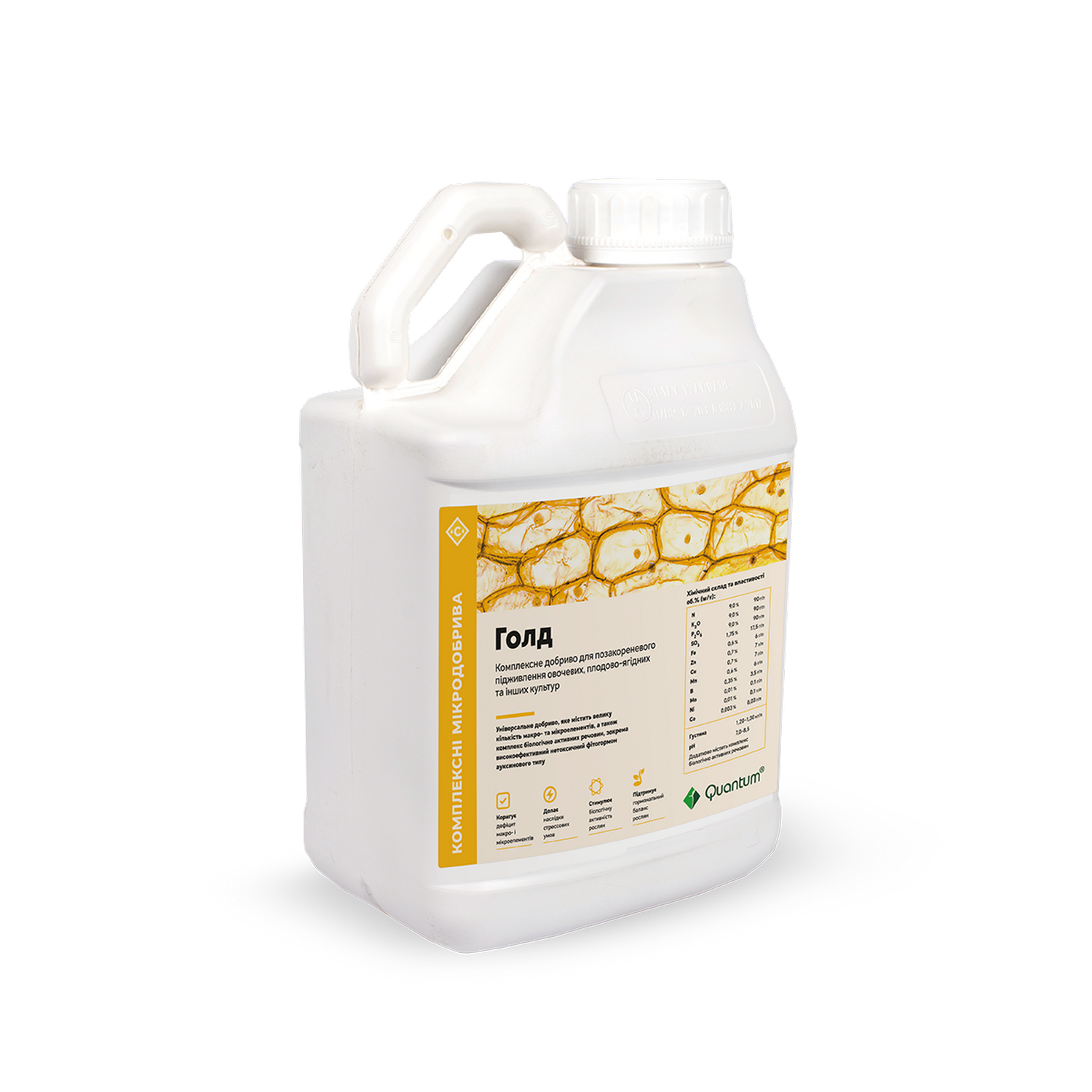
Quantum Gold
A comprehensive fertilizer for foliar feeding of vegetable, fruit, berry, ornamental, and other crops. It contains a high concentration of macro- and micronutrients, as well as a complex of biologically active substances, including an auxin-type phytohormone.
Product information
- N – 9% (90 g/L)
- P₂O₅ – 9% (90 g/L)
- K2O – 9% (90 g/L)
- SO₃ – 1.75% (17.5 g/L)
- Fe – 0.6% (6 g/L)
- B – 0.35% (3.5 g/L)
- Zn – 0.7% (7 g/L)
- Cu – 0.7% (7 g/L)
- Mn – 0.6% (6 g/L)
- Mo – 0.01% (0.1 g/L)
- Ni – 0.01% (0.1 g/L)
- Co – 0.003% (0.03 g/L)
- Also contains a complex of biologically active substances
- pH – 7.5–8.0
- Density – 1.20–1.28 kg/L
Action and Effects of Microfertilizers
Used in foliar feeding systems to:
- correcting temporary deficiencies of macro- and micronutrients and biologically active substances in plants (caused by weather, climate, soil, and chemical factors);
- adjusting the plant fertilization system in cases of absence or deficiency of essential micronutrients in the soil, as well as in intensive farming practices aimed at achieving high crop yields;
- stimulating plant biological activity during critical phases of growth and development to achieve the highest possible plant productivity under specific conditions;
- helping plants overcome the effects of stressful conditions that have led to a slowdown or cessation of growth processes;
- maintaining and regulating the hormonal status of plants.
The synthetic phytohormone contained in the product is an effective immunomodulator and activator of metabolic processes in plants. It acts at the cellular level and stimulates general physiological mechanisms in plants—protection of cell membranes, adaptation, and enhancement of cellular resilience under adverse environmental conditions.
It is a broad-spectrum adaptogen that increases plant resistance to adverse factors such as low and high temperatures, drought, vitamin deficiency, and nutritional imbalance; It helps increase disease resistance, intensifies the synthesis of proteins and nucleic acids, and increases enzyme activity.
Application Method
Soaking the seeds
Soak the seeds for 2–4 hours in a 5–10% solution (for example, dissolve 0.5 L of the product in 5–10 L of water). After soaking, dry the seeds or sow them immediately. Several batches of seeds can be soaked consecutively in this solution.
Potato tuber treatment
Immerse the tubers for a few seconds in a 5–10% solution (for example, dissolve 0.5 L of the product in 5–10 L of water). After soaking, dry the tubers or plant them immediately. Several batches of tubers can be soaked in this solution one after another. It is also possible to uniformly treat 1 metric ton of tubers using any method at a rate of 4 liters of the product per 10–15 liters of water.
Foliar Application
When applying foliar (non-root) fertilization, the application rate of the working solution is:
- for field and vegetable crops – 200–400 L/ha;
- for vineyards and orchards – 500–1,000 L/ha.
Treatment is performed using standard sprayers. The working solution is prepared immediately before application. Fill the tank 2/3 full with water; after the first component has dissolved evenly, add the remaining solution components one by one while stirring thoroughly. It is recommended to apply the treatment in combination with urea (5–15 kg/ha). The biuret content must not exceed 0.8%; otherwise, there is a risk of damaging the plant foliage. If this occurs, reduce the amount of urea. Spraying should be done in the morning or evening. The optimal air temperature is 10–25°C, with wind speeds up to 5 m/s.
Warning: Treatment is not recommended under conditions of low or high air temperatures, intense solar radiation, or strong winds.
Compatibility with Other Agrochemicals
“Quantum” can be applied together with plant protection products and other fertilizers; however, it is not recommended to combine fertilization with herbicide application during the early stages of plant development. Before mixing, it is recommended to check the compatibility of the products: a test preparation of the working solution should not produce a precipitate. Slight cloudiness is acceptable.
For best results, we recommend applying “Quantum” in combination with other products according to the application schedules for the respective crop. See the recommended application schedules for “Quantum” fertilizers.
The “Quantum – GOLD” micronutrient fertilizer is a highly effective product for foliar feeding and seed treatment of field crops (winter and spring wheat, winter and spring barley, winter rye, corn, sunflower, winter and spring rapeseed, mustard, peas, soybeans, sugar beets, and fodder beets, among others) during the periods (growth stages) and at the rates recommended for specialized complex micronutrient fertilizers manufactured by “Kvadrat” (Quantum – GRAINS, Quantum – OILSEEDS, Quantum – LEGUMES, and Quantum – BEETS).
| Vegetables | ||
|---|---|---|
| Crop | Growth and development stage | Application rate, L/ha (L/t) |
| Potatoes | Stem elongation (BBCH 21–39) | 2.0 |
| Budding (BBCH 51–59) | 2.5 | |
| Tomatoes, peppers, eggplants | 4–6 true leaves (BBCH 14–16) | 2.0 |
| Beginning of flowering (BBCH 61–63) | 2.0 | |
| Fruit ripening (BBCH 81–89) (at 7–10-day intervals) |
2.0 | |
| Cucumbers | Seedlings – 3–6 true leaves (BBCH 13–16) | 2.0 |
| Fruiting (BBCH 71–89) (at 7–10-day intervals) |
2.0 | |
| Carrots | 4–6 true leaves (BBCH 14–16) | 1.0 |
| Onions, garlic | 3–6 true leaves (BBCH 13–16) | 2.0 |
| Onion bulb formation begins (BBCH 41–43) | 3.0 | |
| Bulb formation (BBCH 45–49) (at 7–10-day intervals) |
3.0 | |
| Cabbage | 2–3 true leaves (BBCH 12–13) | 2.0 |
| Head formation (BBCH 41–49) (at 7–10-day intervals) |
3.0 | |
| Fruit and Berry Crops | ||
|---|---|---|
| Crop | Growth and development stage | Application rate, L/100 L of water |
| Pome fruits (apple, pear, quince) | Bud break (BBCH 54–56) | 0.2–0.4 |
| Blooming (BBCH 60–69) | 0.2–0.4 | |
| Hazelnut (BBCH 71–72) | 0.2–0.4 | |
| Fruit development until harvest (BBCH 74–89) (at 7–10-day intervals) |
0.2–0.4 | |
| Stone fruits (apricot, peach, sweet cherry, sour cherry, plum) | Blooming (BBCH 61–65) | 0.3–0.5 |
| Petal fall (BBCH 67–69) | 0.2–0.4 | |
| Fruit set (BBCH 71–73) | 0.3–0.5 | |
| Fruit growth until fruiting (BBCH 75–89) (at 7–10-day intervals) |
0.3–0.5 | |
| Grapes | Before flowering (BBCH 53–57) | 0.2–0.4 |
| Flowering (BBCH 61–69) | 0.2–0.4 | |
| Berry growth (BBCH 71–79) (at 7–10-day intervals) |
0.3–0.5 | |
| Berry ripening (BBCH 81–89) (at 7–10-day intervals) |
0.3–0.5 | |
| Currants, raspberries, gooseberries | Beginning of flowering (BBCH 61–64) | 0.5–0.8 |
| Until harvest (BBCH 71–89) | 0.5–0.8 | |
| End of flowering (BBCH 65–69) (at 7–10-day intervals) |
0.5–0.8 | |
| Strawberries | End of flowering to harvest (BBCH 65–89) | 0.5–0.8 |
Packaging
20 л, 5 л, 1 л, 0.3 л
Виробник
Quantum
Вид
Комплексні добрива

Pickup from AGROVIO warehouse
FREE OF CHARGE
Nova Poshta delivery service
According to service rates
Ukrposhta delivery service
According to service rates
Meest delivery service MAIL
According to service rates1.Payment at the post office upon receipt
2.Payment to a Privat Bank card
3.Online payment by card, any bank
4.Cashless payment (with VAT)
1. Only certified products
2. Exchange and return of goods within 14 days
3. Return of cubic containers from the Customer is carried out at the expense of the Manufacturer, provided that the quantity is a multiple of the full load of the truck
(not less than 52 pcs). Return of a smaller volume is carried out at the expense of the Customer.
4. Delivery of microfertilizers TM QUANTUM in a volume of 4000 l or more is carried out at the expense of the Manufacturer. Delivery of a smaller volume of products is carried out at the expense of the Customer.
