CODE: 64
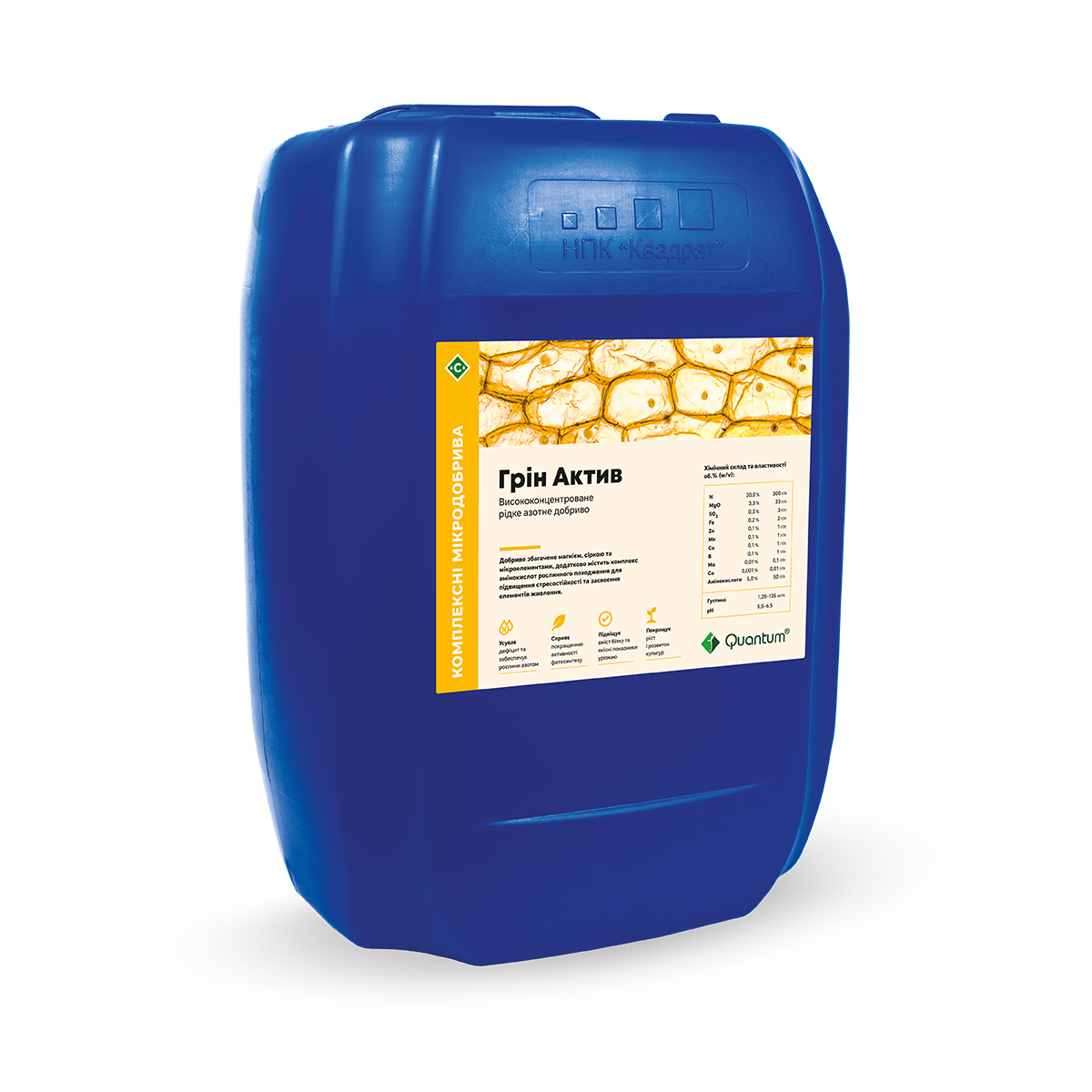
Quantum Green Active
A highly concentrated liquid nitrogen fertilizer for foliar feeding of plants. Enriched with magnesium, sulfur, and micronutrients, it also contains a complex of plant-derived amino acids to enhance stress resistance and nutrient uptake.
Product information
- N — 30% (300 g/L)
- MgO — 3.3% (33 g/L)
- SO₃ — 0.3% (3 g/L)
- Fe — 0.2% (2 g/L)
- Zn — 0.1% (1 g/L)
- Mn — 0.1% (1 g/L)
- Cu — 0.1% (1 g/L)
- B — 0.1% (1 g/L)
- Mo — 0.01% (0.1 g/L)
- Co — 0.001% (0.01 g/L)
- Amino acids — 5% (50 g/L)
- pH — 5.5–6.5
- Density — 1.28–1.35 kg/L
Composition is given in % w/v (weight/volume) — 1% w/v = 10 g/L
N — forms the photosynthetic apparatus; a component of proteins and chlorophyll.
Mg – a component of chlorophyll; participates in chlorophyll biosynthesis, enzyme activation and binding, cellular energy supply, and the distribution of photoassimilates.
Fe, Mo – biosynthesis of chlorophyll and its precursors; influence on the rate of electron transport, the structural and functional integration of membranes, and the intensity of photosynthesis.
Cu, Mn, Zn – are involved in biochemical processes during respiration and photosynthesis, the formation of reaction centers and light-harvesting complexes, the transfer of electrons from PS II to PS I, and are essential for redox enzymatic reactions and in the tricarboxylic acid cycle. The amino acids glycine and glutamic acid are key metabolites in tissue formation and chlorophyll synthesis.
Effects and Benefits of the Microfertilizer
- Used as an effective source of nitrogen for foliar feeding during periods of increased plant nitrogen demand and during critical stages of crop development;
- It improves crop growth and development and helps correct nitrogen deficiency;
- It intensifies biomass growth, increases chlorophyll content, and stimulates photosynthetic activity;
- increases protein content and crop quality indicators;
- amino acids enhance nutrient uptake, activate the enzymatic defense system, and help increase stress tolerance and enable plants to overcome the effects of adverse conditions.
| Field Crops | ||
|---|---|---|
| Crop | Growth and development stage | Application rate, L/ha |
| Cereal crops | Tillering (BBCH 21–29) | 2.5–5.0 |
| Booting – Flag leaf stage (BBCH 30–49) | 2.5–5.0 | |
| Milky-waxy maturity (BBCH 83–87) | 2.5–5.0 | |
| Corn | 3–5 leaves (BBCH 13–15) | 2.5–5.0 |
| 6–8 leaves (BBCH 16–18) | 2.5–5.0 | |
| Start of stem elongation – start of tassel emergence (BBCH 30–51) (at 7–10-day intervals) | 2.5–5.0 | |
| Sunflower | 2–3 pairs of leaves (BBCH 14–16) | 2.5–5.0 |
| 5–6 pairs of leaves (10–12 leaves) (BBCH 30–33) | 2.5–5.0 | |
| Rapeseed | 4–6 leaves (before winter, for winter rapeseed) (BBCH 14–16) | 2.5–5.0 |
| Spring rosette – stem elongation (BBCH 21–39) | 2.5–5.0 | |
| Budding – before flowering (BBCH 50–61) | 2.5–5.0 | |
| Seed formation (BBCH 71–79) | 2.5–5.0 | |
| Soybeans, peas | 3–5 trifoliate leaves (BBCH 14–16) | 2.5–5.0 |
| Budding – beginning of flowering (BBCH 51–61) | 2.0–4.0 | |
| Pod formation (BBCH 71–79) | 2.0–4.0 | |
| Vegetables | ||
|---|---|---|
| Crop | Growth and development stage | Application rate, L/ha |
| Sugar and fodder beets | 4–6 leaves – leaves closing in rows (BBCH 14–34) | 2.5–5.0 |
| Leaves closing between rows – root growth (BBCH 35–49) | 2.5–5.0 | |
| Potatoes | Stem elongation (BBCH 21–39) | 2.0–4.0 |
| Budding – onset of wilting and dieback of foliage (BBCH 51–97) (at 7–10-day intervals) | 2.0–4.0 | |
| Tomatoes, peppers, eggplants | 5–8 leaves (BBCH 15–18) | 2.0–4.0 |
| Budding – onset of fruit ripening (BBCH 51–71) (at 7–10-day intervals) | 2.0–4.0 | |
| Cucumbers | Leaf growth and development (BBCH 13–29) (at 7–10-day intervals) | 2.0–4.0 |
| Budding – fruiting (BBCH 51–89) (at 7–10-day intervals) | 2.0–4.0 | |
| Carrots | 4–6 true leaves (BBCH 14–16) | 2.0–4.0 |
| Root growth (BBCH 41–49) (at 7–10-day intervals) | 2.0–4.0 | |
| Onions, garlic | Onion bulb initiation to the end of bulb filling (BBCH 41–49) (at 7–10-day intervals) | 2.0–4.0 |
| Cabbage | Head formation (BBCH 41–49) (at 7–10-day intervals) | 2.0–4.0 |
| Fruit and Berry Crops | ||
|---|---|---|
| Crop | Growth and development stage | Application rate, L/100 L of water |
| Pome fruits (apple, pear, quince) | Bud break (BBCH 51–59) | 0.3–0.7 |
| Post-bloom (BBCH 71–72) | 0.3–0.7 | |
| Fruit development – harvest (BBCH 74–89) (at 7–10-day intervals) | 0.3–0.7 | |
| Stone fruits (apricot, peach, sweet cherry, sour cherry) | Bud set (BBCH 51–59) | 0.3–0.7 |
| Petal fall (BBCH 67–69) | 0.3–0.7 | |
| Fruit set (BBCH 71–73) (at 7–10-day intervals) | 0.3–0.7 | |
| Grapes | Flowering (BBCH 61–69) | 0.3–0.7 |
| Berry growth (BBCH 71–79) (at 7–10-day intervals) | 0.3–0.7 | |
| Berries (strawberries, currants, raspberries) | Leaf growth, start of stolon formation – bud set (BBCH 41–59) | 2.0–4.0 |
| Flowering stage (BBCH 61–69) (at 7–10-day intervals) | 0.7–1.2 | |
| Nuts | Fruit set and development (BBCH 71–89) (at 7–10-day intervals) | 0.3–0.7 |
Packaging
20 л
Виробник
Quantum
Вид
Азотні добрива

Pickup from AGROVIO warehouse
FREE OF CHARGE
Nova Poshta delivery service
According to service rates
Ukrposhta delivery service
According to service rates
Meest delivery service MAIL
According to service rates1.Payment at the post office upon receipt
2.Payment to a Privat Bank card
3.Online payment by card, any bank
4.Cashless payment (with VAT)
1. Only certified products
2. Exchange and return of goods within 14 days
3. Return of cubic containers from the Customer is carried out at the expense of the Manufacturer, provided that the quantity is a multiple of the full load of the truck
(not less than 52 pcs). Return of a smaller volume is carried out at the expense of the Customer.
4. Delivery of microfertilizers TM QUANTUM in a volume of 4000 l or more is carried out at the expense of the Manufacturer. Delivery of a smaller volume of products is carried out at the expense of the Customer.
